Baghouses and cartridge collectors are usually designed to handle a maximum of 6” W.C. of pressure drop. When the baghouse pressure drop is 6” W.C., the airflow through the system is enough for proper operation. When the pressure drop across the bags is greater than 6” W.C., the airflow through the system is less than it should be. The baghouse uses a control system to keep the pressure drop through the system to less than 6” W.C. Most baghouses use compressed air to clean the bags, but shaking and sonic cleaners are also used.
Posts about Dust Collectors (9):
It’s a New Year…Have You Checked Your Dust Collector??
A simple dust collection system is composed of the exhaust fan, dust collector (cyclone, baghouse, cartridge collector, wet scrubber, etc.), ductwork, and hoods. An issue with one of these components could cause your dust collection system to fail or not work as designed. However, the dust collector is usually the most complex component and the most likely to develop issues, but is often the most neglected. Just like an automobile, proper maintenance of a dust collector could save a whole lot of issues in the future.
Why Do I Need an Airlock Valve for My Dust Collector
In order for a dust collector to operate at its peak performance, the hopper has to be isolated from the outside. This means either the dust bin/receptacle is “hard connected”, meaning there are no air leaks or an airlock is used. An airlock isolates the dust collector hopper from the outside, while allowing the collected dust to exit the system. Common airlocks are rotary valves, trickle valves, double dump valves, and knife gates. Some airlocks are low leakage (double dump valve and trickle valves) while others have continuous leakage (rotary valves).
Hoods – A Vital Component in a Dust Collection System
Hoods are probably most important component in a dust collection system because they will:
The Benefits of Using a VFD On a Dust Collection Exhaust Fan
Variable Frequency Drives allows for you to control the airflow through your system by changing the fan speed without breaking the bank. Without VFDs, one has to manually open or close dampers, creating high manual labor cost. Furthermore, if there are multiple dampers on the system, then tampering with the opening and closing of any one damper, can cause the airflow balance to be off and can increase the static pressure of the system. 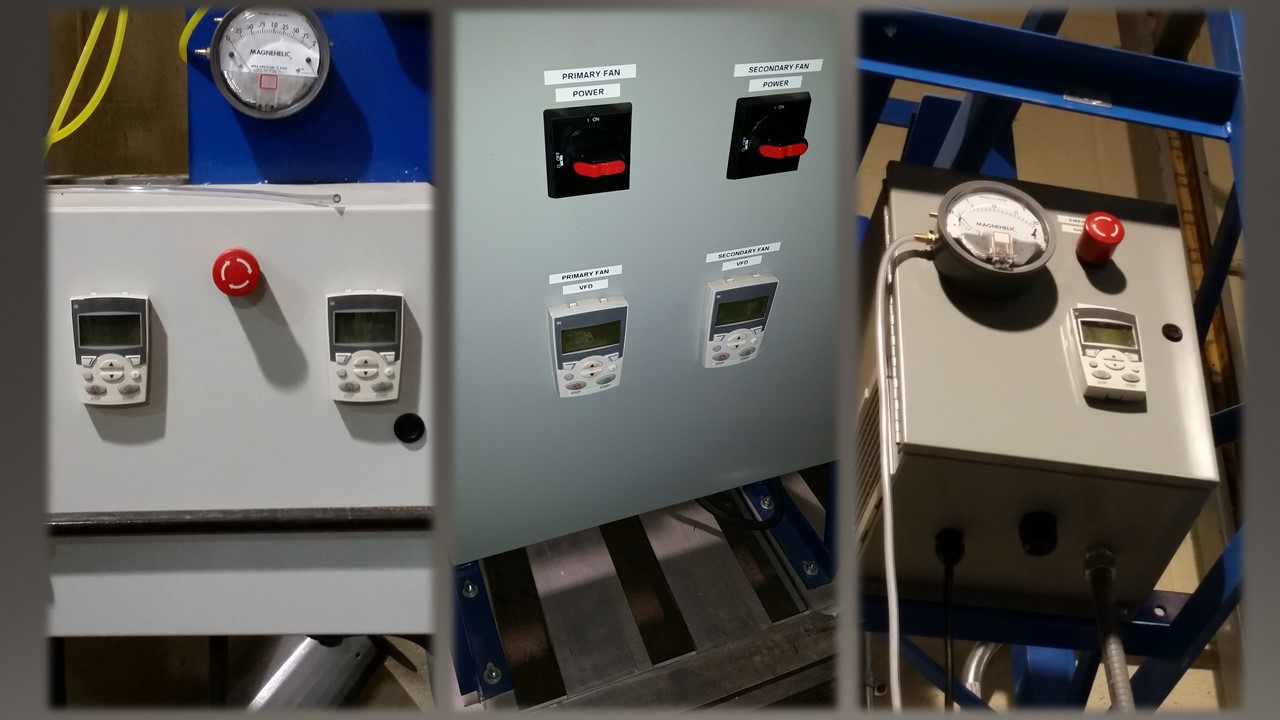
The VFD allows you to control the airflow of the fan, rather than allowing a constant high air output, as would be the case when dampers are being used. VFDs give the system the airflow that is required while lowering electrical costs. VFDs can further lower costs by replacing motor starter control panels. All in all, using a VFD is the smart way to control your airflow.
If you are having operational issues on your dust collection system contact Aerodyne at 440-543-7400 or dc@dustcollectorhq.com to help you problem solve your dust collection problems.
Which 4 major items can cause a dust collection system to underperform?
Dust collection systems consist of four major items. All of them are important and can cause a dust collection system to underperform. The major items are the exhaust fan, dust collector, ductwork, and hoods/pickup points. While the exhaust fan provides the motive power to collect the dusty air, its performance is affected by each of the components. This means that if one of the other components isn’t operating as designed, the whole system will be affected. Ductwork is usually by far the largest component and often the most overlooked. Depending on the size of your system, the ductwork can span hundreds of feet and have dozens of side streams. The ductwork is like railroad tracks, it moves the dusty air from one place to another.
Dust Collection Systems: Rotary Valves and NFPA-69
When you have a combustible dust, not only does your dust collector require to be protected against a deflagration, but the airlock must contain the event. NFPA-69 allows the use of a rotary valve as long as the following:
Dust Collection Systems: Instrumentation 101 – Differential Pressure Gages
A dust collection system is much more than just the dust collector (ex. Cyclone, baghouse, cartridge collector, wet scrubber, etc.). It constitutes the exhaust fan, hoods, instrumentation and interconnecting ductwork. If any of these components are improperly sized or operating, the whole system can fail in its primary objective, dust collection.
Dust Collection Systems: Fan Wheels 101
A dust collection system is much more than just the dust collector (ex. Cyclone, baghouse, cartridge collector, wet scrubber, etc.). It constitutes the exhaust fan, hoods, instrumentation and interconnecting ductwork. If any of these components are improperly sized or operating, the whole system can fail in its primary objective, dust collection.
Case Study: Compact Cyclone Key Component in Tablet Dust Reclamation? GPC Helps Keep Pharmaceutical Process in Check with FDA
Aerodyne Environmental, the industry’s leading manufacturer of industrial cyclonic dust collectors and dust collection valves, recently assisted in a pharmaceutical application. A prominent US pharmaceutical company was creating a dust collection system for the facility where a variety of drugs are manufactured. The company plans on using a cartridge collector as part of the tablet manufacturing process. Because this company is regulated by the FDA, every gram of product must be accounted for, even the dust. The active pharmaceutical ingredients (APIs) that are created are extremely fine and flow like water. The cartridge collector would be able to collect the particulate in the process, but much of it would get stuck in the filters and would be hard to account for. Read more about this case study.