Dust collections systems are complex entities. They consist of multiple pieces of equipment, and if one of them is not operating correctly, could cause the failure of the whole system. All dust collection systems consist of the dust collector (cyclone, baghouse, cartridge collector, wet scrubber), exhaust fan, ductwork and hood/pickup points. Each of these is extremely important to the operation of the system.
High Differential Pressure: 6 Warning Signs your Baghouse or Cartridge Collector Might Fail
Baghouses and cartridge collectors are usually designed to handle a maximum of 6” W.C. of pressure drop. When the baghouse pressure drop is 6” W.C., the airflow through the system is enough for proper operation. When the pressure drop across the bags is greater than 6” W.C., the airflow through the system is less than it should be. The baghouse uses a control system to keep the pressure drop through the system to less than 6” W.C. Most baghouses use compressed air to clean the bags, but shaking and sonic cleaners are also used.
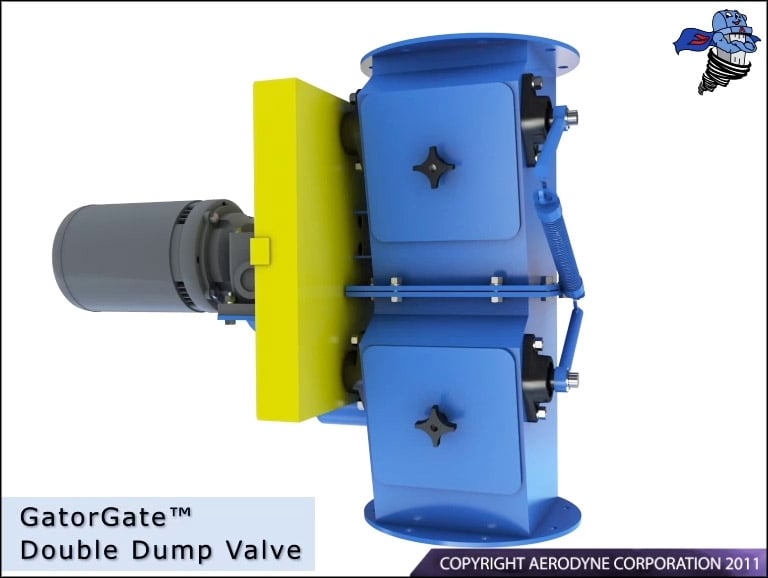
Reduce Air Leakage with the Aerodyne Double Dump Valve
When your dust collectors are having issues, one of the first places to look is the airlock valve. Often times, dust is hygroscopic and when outside air leaks into the system, humidity follows. This can cause the dust to absorb the humidity and become sticky or harden like cement. This can lead to plugged filters, hoppers and damage to rotary valves. While rotary valves are the industry standard airlock, they constantly allow air leakage. A low leakage valve is required. Double dump valves however are very low leakage, since there is no direct connection to the outside atmosphere. The valve always isolates the conditions above it from the conditions below it. This minimizes air leakage, thereby minimizing humidity from affecting the dust.
It’s a New Year…Have You Checked Your Dust Collector??
A simple dust collection system is composed of the exhaust fan, dust collector (cyclone, baghouse, cartridge collector, wet scrubber, etc.), ductwork, and hoods. An issue with one of these components could cause your dust collection system to fail or not work as designed. However, the dust collector is usually the most complex component and the most likely to develop issues, but is often the most neglected. Just like an automobile, proper maintenance of a dust collector could save a whole lot of issues in the future.
Why Do I Need an Airlock Valve for My Dust Collector
In order for a dust collector to operate at its peak performance, the hopper has to be isolated from the outside. This means either the dust bin/receptacle is “hard connected”, meaning there are no air leaks or an airlock is used. An airlock isolates the dust collector hopper from the outside, while allowing the collected dust to exit the system. Common airlocks are rotary valves, trickle valves, double dump valves, and knife gates. Some airlocks are low leakage (double dump valve and trickle valves) while others have continuous leakage (rotary valves).
Why You Should Pay Attention to Air Velocity in Your Dust Collection System
 If your air velocity is too low in your ductwork you could get dust dropping out in straight runs. And dust collecting in ductwork is not a very good idea.
Are you wasting time using compressed air to clean your baghouse or cartridge collector?
Baghouses and cartridge collectors often use compressed air / plant air to clean the filters. By pushing compressed air through the filter, in theory, dust should be removed from the filters. However, air compressors are high maintenance pieces of equipment that have high operating costs. Also, the filters are never completely dust free after an air blast, meaning that, over time they become blinded. This high time-and-monetary cost can be lowered by breaking away from using compressed air and instead using a cyclone pre-filter in your dust collection system.
Hoods – A Vital Component in a Dust Collection System
Hoods are probably most important component in a dust collection system because they will:
The Benefits of Using a VFD On a Dust Collection Exhaust Fan
Variable Frequency Drives allows for you to control the airflow through your system by changing the fan speed without breaking the bank. Without VFDs, one has to manually open or close dampers, creating high manual labor cost. Furthermore, if there are multiple dampers on the system, then tampering with the opening and closing of any one damper, can cause the airflow balance to be off and can increase the static pressure of the system. 
The VFD allows you to control the airflow of the fan, rather than allowing a constant high air output, as would be the case when dampers are being used. VFDs give the system the airflow that is required while lowering electrical costs. VFDs can further lower costs by replacing motor starter control panels. All in all, using a VFD is the smart way to control your airflow.
If you are having operational issues on your dust collection system contact Aerodyne at 440-543-7400 or dc@dustcollectorhq.com to help you problem solve your dust collection problems.
How Important are Dampers in a Dust Collection System?
Dampers are used in dust collection systems to control the airflow to specific branches of the ductwork. This is done by opening or closing the damper. Air, like water, travels the path of least resistance. By using a damper, you are changing the resistance to the air. Every dust collection system should have a manual damper near each hood/pickup point to balance the syst em. This makes sure that the system is properly operating. An unbalanced system could cause too much air to be pulled from one area (causing loss of product) while in another area not enough airflow is available to capture dust. Other times, a soft connect (space between flanges) is used to control airflow at a pickup point. However, this isn’t very efficient. This keeps the airflow in that area constant, but it’s picking up air from an area where it isn’t required. A damper would work much better, since you are only moving the air in the area you need. Soft connects are only advantageous when you are looking to cool down an airflow using outside air. Dampers can also be used to shut off portions of the system that are not being used, thereby allowing a smaller system.