Now more than ever, continuously monitoring the effectiveness of your organization’s security controls is essential. Continuous Controls Monitoring (CCM) provides a...
Now more than ever, continuously monitoring the effectiveness of your organization’s security controls is essential. Continuous Controls Monitoring (CCM) provides a...
Identifying how and where Controlled Unclassified Information (CUI) is stored, transmitted, and processed within your organization is a critical first step to achieving CMMC compliance. Many organizations overlook this step, however, leading to gap assessment fatigue, unwanted costs, and a lack of leadership and organizational buy-in.
Planning on using your SIEM to track CMMC or DFARS compliance?
While this task is possible, configuring your SIEM to accurately monitor many of the 320 NIST 800-171 objectives is a massive undertaking that requires significant time, resources, and expertise. ASCERA, on the other hand, integrates with your SIEM to automatically monitor these objectives – no additional configuration required.
Here’s a deeper look at what sets ASCERA apart from a SIEM.
A SIEM (Security Information and Event Management) system collects, analyzes, and monitors security-related data from across an organization’s IT infrastructure. It identifies security threats in real-time by aggregating logs and events from various sources.
A SIEM is helpful tool for compliance – you can use the data it collects as evidence for meeting various controls. But without additional configuration, you’ll be left sifting through an overwhelming sea of data to try to pinpoint which information is relevant to use as evidence for hundreds of controls/objectives.
To configure a SIEM for CMMC compliance, you would need to identify relevant log sources, configure log collection, and develop compliance rules for dozens of technical controls and objectives. This demands a high level of expertise in both NIST 800-171 and SIEM technology.
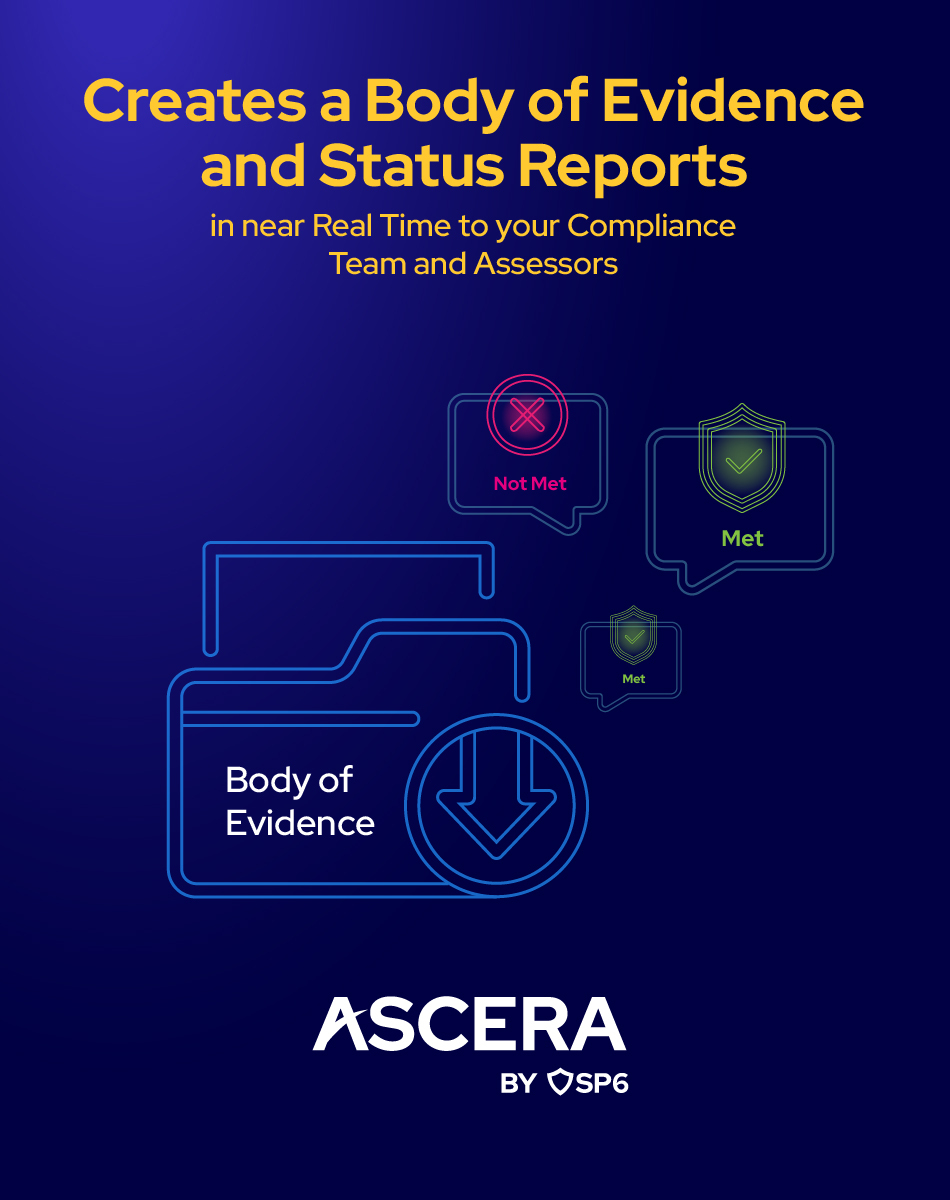
ASCERA uses the data that your SIEM provides to automate evidence collection and status reporting for over half of NIST 800-171 controls. By doing so, it cuts the amount of manual labor required for CMMC / DFARS compliance in half.
ASCERA follows a three-step process:
The main difference between using ASCERA and using a SIEM for compliance is that ASCERA eliminates the hours of set-up/configuration time. ASCERA comes with all 110 controls and 320 objectives pre-configured, so you can start tracking your status as soon as your SIEM is integrated.
ASCERA significantly reduces the amount of manual, administrative labor required for compliance by automating evidence collection and status reporting for NIST 800-171 controls. There are three main benefits to using ASCERA in addition to a SIEM for CMMC compliance:
Evidence collection is a tedious process that ASCERA reduces by over half. Although a SIEM could eventually be set up to pull specific data for specific controls, the set-up process would be arduous. ASCERA comes ready-to-go, saving organizations invaluable amounts of time and effort.
ASCERA increases the integrity of your data and significantly reduces the opportunity for human error. You won’t accidentally pull the wrong data for the wrong control, as ASCERA’s automated technology is pre-programmed by Certified CMMC Assessors and Professionals to gather the right data for you.
Similarly, ASCERA eliminates the ambiguity of confusing controls. You might be unsure of which evidence to pull for certain controls, but with ASCERA, the decision is made for you. You’ll be able to monitor the pulled data and compliance status of each control, plus see detailed descriptions backing each met/not-met status.
Ready to discover how ASCERA can save your organization time, money, and effort? Get started with a demo today, or read more about how ASCERA works.
In today’s regulatory compliance landscape, many organizations experience what’s known as “gap assessment fatigue.” This frustration stems from the repetitive and time-consuming task of manually collecting evidence (e.g., screenshots) to identify and assess compliance gaps. Often times, this resembles an endless game of whac-a-mole.

In the ever-evolving landscape of compliance, the responsibilities of security compliance professionals have grown exponentially. Amidst the complexity of compliance frameworks and the constant barrage of cross-organization requests, the list of pain points your team faces goes on and on.
In the current state of security compliance, it’s critical to be secure and compliant at all times. No longer is it acceptable to simply be compliant on the day of an assessment, but rather, executives are expected to maintain a comprehensive security compliance program. That’s where Continuous Controls Monitoring comes in.
Continuous Controls Monitoring (CCM) refers to the use of automated tools and processes to monitor and assess the effectiveness of a company’s controls on a continuous basis.
This is a valid question. The short answer is, CCM can drastically reduce security compliance risks as well as costs of achieving compliance, developing a cyber risk program, and maintaining your compliance program.
The long answer is to consider how your organization prepares for a cybersecurity assessment, how many resources are spent chasing down technical configurations from security asset owners, and how documenting control readiness and evidence is managed. Meanwhile, when the independent assessor arrives, the fears (often unnecessary) of control gaps come:
Traditionally, to prepare for an assessment, compliance professionals have heavily relied on tools like Excel and Word for managing data collection and reporting processes, while painstakingly requesting screenshots and documentation from subject matter experts across the organization.
These methods not only consume a considerable amount of time and effort but are also prone to human error resulting in risks going unaddressed. CCM reduces compliance risk by enabling security controls and control owners, allowing for a more streamlined procedure for monitoring and assessing their effectiveness continuously.
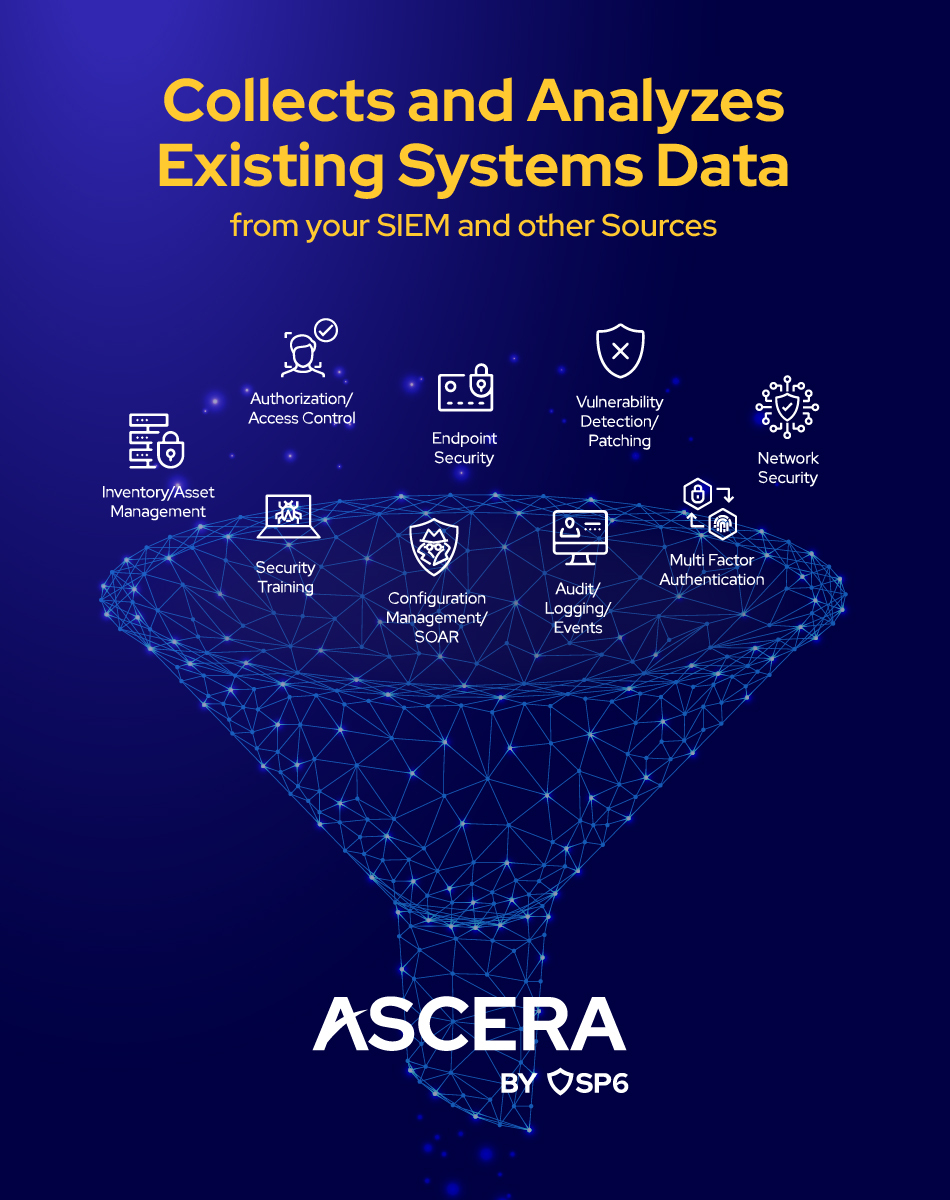
Continuous Controls Monitoring with ASCERA leverages system data through existing security technology investments. This maximizes the effectiveness of your organization’s solutions, such as firewalls, intrusion detection systems, and security information and event management (SIEM) platforms by integrating and analyzing data across these systems.
This data is considered actual state i.e., the actual state of your system in the form of logs and machine-readable data.
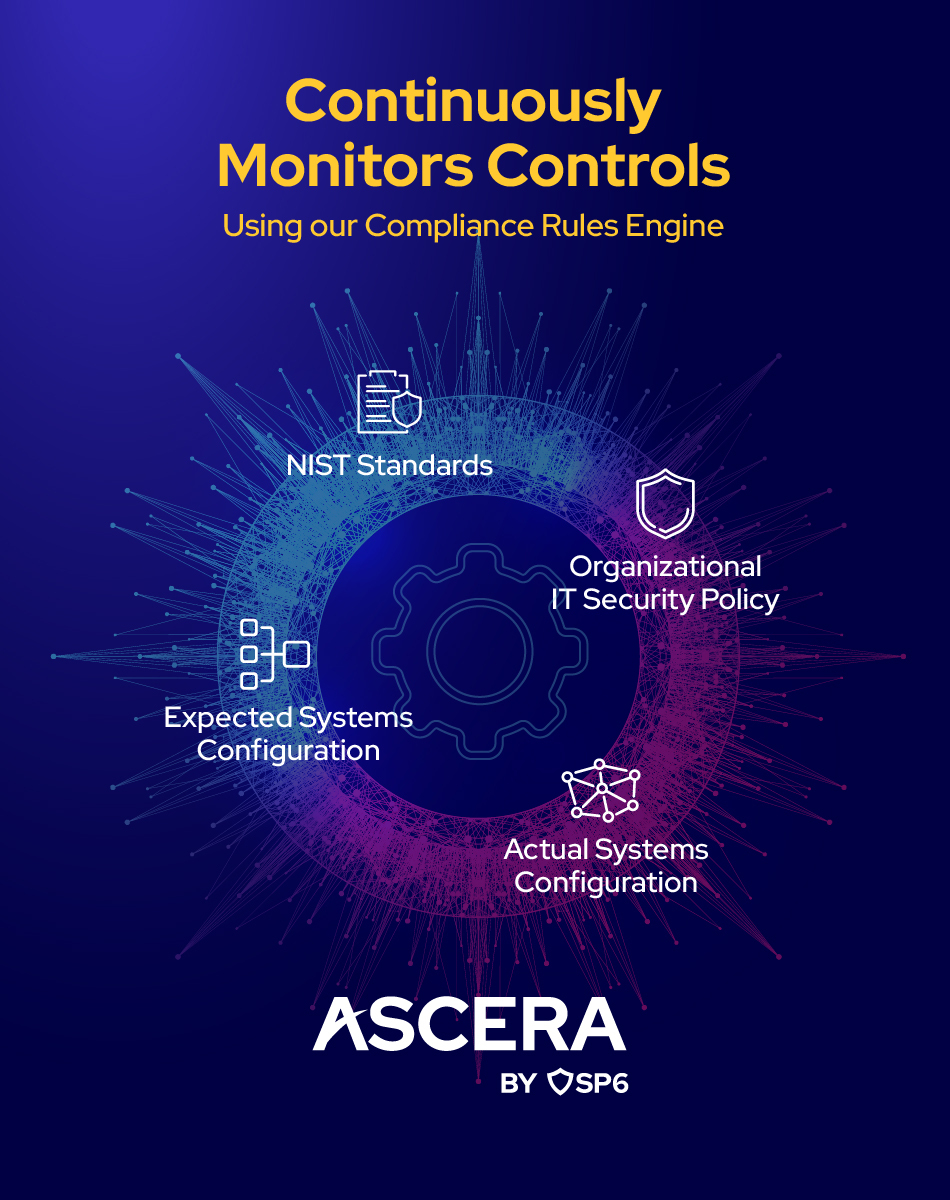
This data feeds into the ASCERA compliance rules engine consisting of regulatory requirements, organization-specific policies, and tailored security control frameworks making up your desired state. The rules engine, in real-time, determines if your environment is meeting the desired state by comparing the system data of your actual state.
As a result, ASCERA CCM provides you real-time insight into the status of your control effectiveness and alerts your team if your controls are drifting out of compliance. This approach shifts your compliance program into a proactive state, rather than reacting to inconsistent point-in-time assessments.
Control: NIST 800-53: AU-11 Audit Record Retention, NIST 800-171: 3.3.1[e] [f] System Auditing
Using the CCM methodology, ASCERA compares your logging retention policy (desired state) against existing log records of all log sources and assets in your environment (actual state). As a result, this practice objectively determines if all log sources and assets meet the required retention period to support an investigation of incidents.
If any log sources or assets in your environment do not meet the log retention requirements, your team will be notified and be able to drill down into the compliance gap to facilitate remediation.
Your proactive security compliance program will know in real-time if log retention requirements have not been met, and more importantly, your team will have visibility before going into an assessment that all assets are meeting requirements.
With CCM becoming a requirement of the most common security compliance frameworks, understanding the basics is essential. If your organization is seeking compliance certification or needs to maintainits current status, solutions that automate CCM can bolster assurance and convenience. ASCERA is a tool that applies the CCM methodologyto bridge the gap between your organization’s actual state and desired state. To learn if it’s a good option for your organization’s CCM needs, chat with one of our solutions advisors today!