
Tailored for healthcare enthusiasts, this article provides insights from experts on the dynamic landscape of healthcare M&A. Learn about the latest healthcare M&A deals...
Blockchain was first introduced over a decade ago and there has been quite a bit of buzz with this technology! It has become a game-changing innovation that serves many industries and businesses. Let’s dive into this disruptive technology together!
Simply, blockchain is a database without intermediaries where parties agree on the information in the database. Deloitte notes that the attractiveness of this technology comes from the fact that blockchain stores data in blocks that are then chained together. This allows data to be:
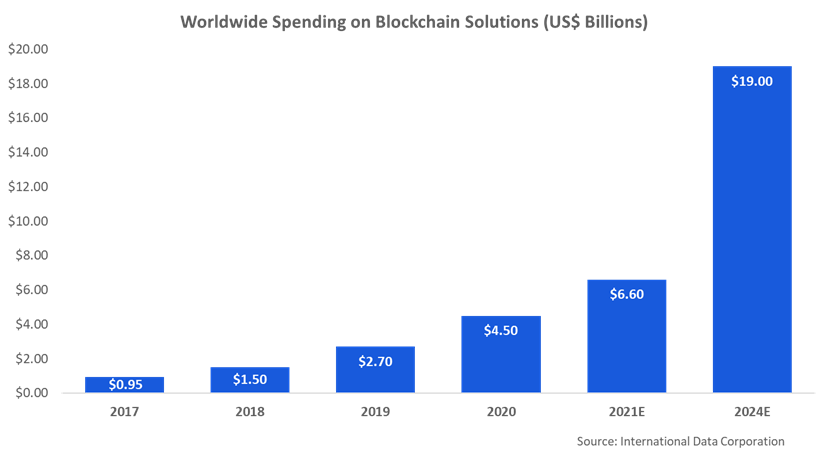
According to the International Data Corporation (IDC), organizations globally spent nearly $4.5B on blockchain solutions in 2020. This is expected to climb to $6.6B by the end of 2021 and up to $19B in 2024 (at a 48% CAGR 2020–2024).
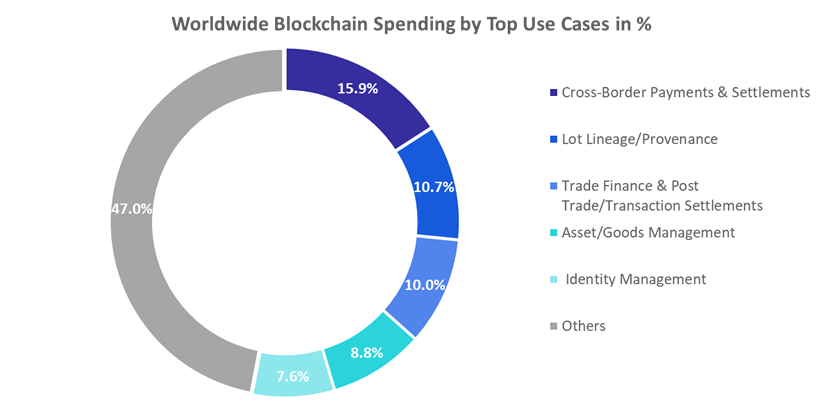
Blockchain technology is used in varied industries and already has a significant impact on the global economy. The banking industry leads the way in blockchain spending (30% worldwide in 2021) where its primary use relates to cross-border payments and trade finance. The manufacturing industry follows with 20% of global blockchain spending and primarily uses blockchain in supply chain management. Following are the retail, professional services, and insurance industries.
Regionally, the United States leads with $2.6B spending on blockchain technology, followed by Western Europe and China with $1.6B and $0.8B, respectively.
Most Popular Blockchain Uses PWC sheds some light on the most popular blockchain uses which include:
1. Decentralized Finance (DeFi): including “Payments Crypto and digital Assets” (e.g., Ethereum, Bitcoin, and other altcoins) and Non-Fungible Tokens (NFTs can be found in the gaming, art, and collectible ecosystems).
2. Supply Chain Management: including companies using blockchain technology to trace the origin and status of assets throughout a supply chain, combining hardware components such as IoT-enabled sensors with blockchain software to connect physical goods to decentralized tracking systems.
3. GRC (Governance, Risk, and Compliance) Management and Identity: although this area is in the nascent stages of implementation, it has the potential to reduce pain points with auditing working paper management and securely store third-party information. Additionally, blockchain is a good ally when it comes to verifying information to comply with KYC (“know-your-customer”) regulatory requirements.
Get in touch with the Finalis Insights Team to learn how Finalis can help you stay up to date with your industry!
Tailored for healthcare enthusiasts, this article provides insights from experts on the dynamic landscape of healthcare M&A. Learn about the latest healthcare M&A deals...

At Finalis, our members bring decades of experience, deep expertise, and fresh perspectives to the private capital markets. In this edition of Inside The Network, we...