
Law firm technology isn’t just a luxury—it’s a necessity for any modern law firm.
The average billable hours for attorneys can swing widely, influenced by elements such as the size and reputation of the law firm, the attorney’s level of experience, and the area of law practiced.
Calculating how many billable hours as a law firm can be tough. The question always pops up: “How many hours do most lawyers bill?” By giving you insights into the average billable hours for attorneys and how they fit into daily legal practice we can bring some clarity. Let’s simplify this topic and get into the numbers.
Billable hours are a cornerstone of the legal industry, representing the hours attorneys work that can be billed to clients. For law firms, understanding billable hours is necessary for managing time effectively, optimizing billing processes, and maintaining a healthy work-life balance. By grasping the concept of billable hours, law firms can ensure they are maximizing their productivity and profitability.
Billable hours refer to the time attorneys spend on tasks that can be directly billed to clients. These tasks include meeting with clients, conducting legal research, preparing documents, and attending court hearings. To accurately record and calculate the time spent on each task, attorneys often use a billable hours chart. This chart helps in tracking the time spent on various activities, ensuring that every minute of billable work is accounted for.
The average billable hours for attorneys can vary greatly depending on the size and reputation of the law firm, the attorney’s experience and the area of law practiced. The firm’s billable hours are a key metric for assessing overall productivity and efficiency.
For example, a new associate in a small to mid-sized firm is expected to log around 1,900 hours a year. In a larger, more prestigious firm with over 700 attorneys, this can creep up to 1,930 hours.
To put these numbers into perspective, 1,800 billable hours would mean regular office hours plus 20 minutes from Monday to Friday. Or, one full Saturday a month from 10:00 a.m. to 5:00 p.m.
For those targeting 2,200 billable hours, the schedule gets more demanding, 8:00 a.m. to 8:00 p.m. Monday to Friday and two Saturdays a month. Now that we have the yearly numbers, let’s look at the average billable hours per month.
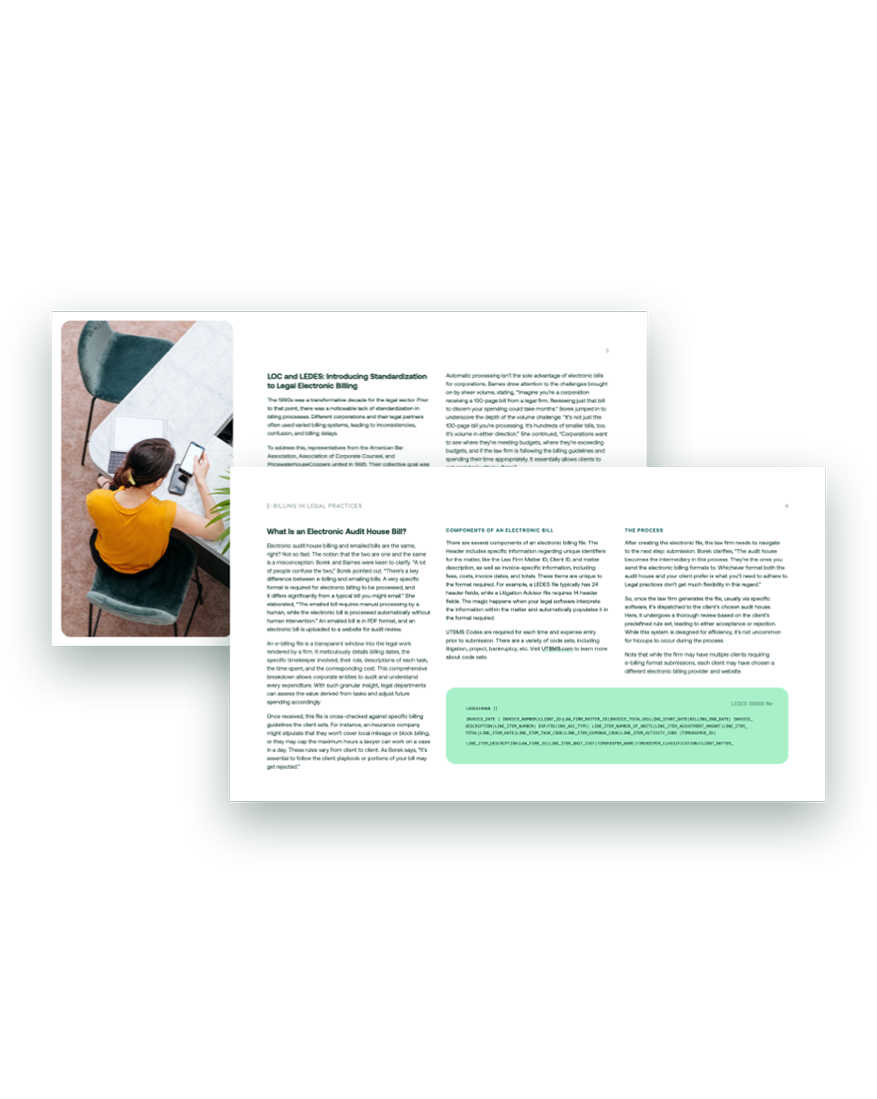
Download our whitepaper Decoding the World of E-Billing for a detailed explanation on when to use LOC and LEDES billing, and more.
Understanding the yearly billable hour requirement is key. To effectively manage your workload, it’s essential to calculate billable hours on a monthly basis. Looking at this requirement in terms of average billable hours per month makes it more manageable. 1,900 billable hours a year is about 158 billable hours a month. Average billable hours per month do not include holidays, sick leaves or vacation days, these non-working days need to be considered when planning the annual workload.
Non-billable duties such as administrative tasks, business development and continuing legal education are also part of the attorney’s job. While these tasks don’t contribute to the average billable hour requirement, they are essential for professional growth and the firm’s smooth operation. With these monthly numbers in mind, it’s time to ask the question, “Is 1,900-2,000 billable hours a lot?”

Day-to-day tasks within CARET Legal
The question of “Is 1,900-2,000 billable hours a lot?” can be subjective, often resting on individual work habits, personal capacity, and the nature of the cases being handled.
Maximizing billable hours requires effective time management and a strategic approach to balancing various tasks. For some it might seem daunting. But considering the intensive training and the demanding nature of legal studies, it’s a target that while challenging is achievable.
Remember, these numbers don’t just mean time spent in court or with clients. It also includes time spent on research, drafting legal documents and other non-billable activities that are crucial to case preparation. So while 1,900-2,000 billable hours might seem like a lot, it’s all part of the job description and essential to the operation of a law firm. All things considered, let’s talk about the billable hour requirement set by most law firms.

Billable Hours Recap report in CARET Legal
Most law firms set a yearly billable hour target for their associates. Using an attorney billable hours chart can help in systematically documenting and managing these targets. This number is usually between 1,700 to 2,300 hours which is the average billable hour requirement.
This requirement is a key performance indicator for attorneys, a benchmark for individual and firm wide productivity. The billable hour requirement is not just a random number, it’s calculated based on the firm’s operational costs, expected revenue and market standards. It also takes into account the lawyer’s role, experience and specialization. Meeting or beating this target can often result to bonus compensation, a big incentive to work hard. But there are sometimes unspoken expectations. For example, a firm may officially require 1,900 billable hours but the underlying expectation is 2,000 hours. Understanding these nuances is key as it can affect targets and overall approach to workload management. Meeting the average billable hour requirement is not just about logging hours; it’s about effective and efficient use of time. It’s about balancing client service with firm profitability.

CARET Legal time entries
Tracking billable hours is a critical aspect of law firm management. Accurate time tracking enables law firms to optimize their billing processes, reduce errors, and improve client satisfaction. By meticulously tracking billable hours, law firms can ensure they are billing clients accurately and fairly, which in turn helps in building trust and maintaining long-term client relationships.
Effective time tracking strategies are essential for law firms to maximize their billable hours. Here are some strategies to consider:
Excluding time spent attracting clients, non-billable hours spent retaining clients, managing them, doing billing and collections and other tasks can add up. Effective strategies for managing billable hours can significantly enhance a firm’s profitability.
Human error can consume many of those hours which not only wastes time but can lead to even more extensive and costly problems. An ABA study found that administrative errors – such as incorrect calendaring, clerical errors, failure to file documents, procrastination, lost files/evidence, etc. – made up 23% of all malpractice claims a few years ago.
Firms looking to increase efficiency and boost the bottom line should explore ways to reduce time spent on non-billable tasks so lawyers can have more time to work on client focused billable activities.
Legal practice management technology is one of the best ways to increase lawyer efficiency, reduce time and resources spent on manual efforts and minimize costly human mistakes. Specifically, automating file maintenance, calendaring, timekeeping and payment/billing processes will give lawyers more time to service clients, generate new business and drive profit. Practice management software tracks hours in the background as firm staff works on client matters and enables online invoicing. Automatic payments means faster processing than paper billing systems, and ensures the collections process moves faster and missed payments are less likely.
While traditional billable hour models are common, they may not be the best fit for every law firm. Alternative models, such as flat fees and value-based billing, can provide more flexibility and transparency for clients. These models can help law firms differentiate themselves from competitors and offer more predictable pricing for clients.
Flat fees and value-based billing models offer an alternative to traditional billable hour models. These models involve charging clients a fixed fee for a specific service or project, rather than billing by the hour. This approach can provide more transparency and predictability for clients, and can help law firms stand out in a competitive market.
By understanding billable hours, tracking time effectively, and exploring alternative billing models, law firms can optimize their billing processes, improve client satisfaction, and maintain a healthy work-life balance.
Getting a handle on the typical billable hours for attorneys is a key piece of the legal profession puzzle. It’s all about setting achievable expectations, having a solid performance benchmark, and understanding a lawyer’s worth to their firm. Whether we’re talking 1,900 hours over the course of a year or 158 hours in a month, these figures are just part of the territory. So, even though 1,900-2,000 billable hours may sound like a mountain, with the right mindset, savvy time management, and a clear understanding of what goes into these hours, it’s a summit that’s absolutely conquerable.
Ready to make it even easier? Start a free trial of CARET Legal today!
Law firm technology isn’t just a luxury—it’s a necessity for any modern law firm.

Enter law firm management software—an innovative solution that not only addresses the challenges of outsourcing law firm administrative support, but also offers a host...