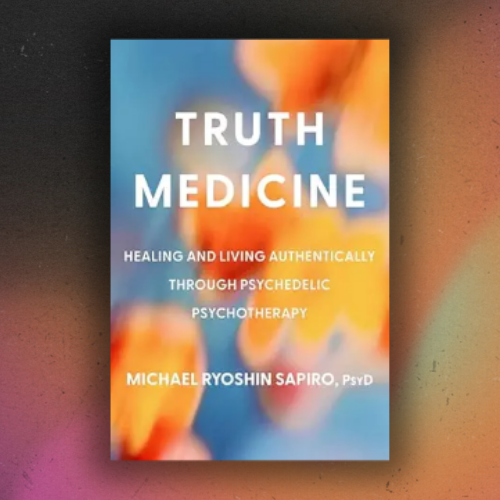
Enjoy this excerpt from Truth Medicine: Healing and Living Authentically Through Psychedelic Psychotherapy, written by IONS Fellow Michael Ryoshin Sapiro, PsyD. The book explains why we often feel stuck and are unable to move forward into a life of thriving, and how psychedelic psychotherapy addresses these essential questions for our well-being.
Chapter 1
Is life as hard for you as it is for me? It’s hard being human, isn’t it?! I was taught that I would finally receive the approval and love I always wanted after I met some expectations that I later learned were unreasonable and unrealistic. I spent most of my life giving more than was healthy, allowing others to violate my boundaries, which I didn’t even know I let happen, and working myself to burnout and exhaustion because I thought that was how I had to earn love and demonstrate my worth. My PTSD symptoms used to get so bad at times that I would find myself looking out the window waiting for “them” to show up, although I was never sure who “they” were. Now I know that my grandparents’ horrific experiences during the Holocaust were passed down through epigenetic changes and intergenerational transmission of trauma, which programmed my mother and me (and many in my family) to be on guard and hypervigilant as a baseline.
Like many of you reading this, I suffer the slings and arrows of being human, of living in a body that is hyperalert and jumpy, of feeling dread and despair, and of having beliefs that are not my own that steer me toward living a life not in alignment with who I actually am. I have been working for decades on my own healing and growth while serving others assisting in their awakening to their own truths. To help myself thrive, I practice meditation daily, engage in depth therapy, use plant medicine in rituals and ceremonies, and dance and play with my community; I found my life’s purpose in serving others. And still, in the many years I have been serving others and healing myself, I have found nothing more powerful than psychedelic psychotherapy (PP) to aid in transformation.
This chapter illuminates some ways psychedelic psychotherapy is vastly different from and much more expansive in its scope than other mental health therapies. Even the gold standard therapies do not address all the domains I cover in this book based on my therapeutic model. The main difference between traditional therapy and PP is that in psychedelic-assisted therapy clients engage in deep therapy while the ego has lost its hold on reality, which allows the heart to speak its truth and the universe to provide its support through images, symbols, signs, and experiences of the cosmos.
As I will discuss throughout the book, I have never seen or experienced any healing modality that covers so many facets of what it means to be human while connecting us back to our own humanity as the process of psychedelic psychotherapy does.
Psychedelic medicine and the accompanying psychotherapy are changing the mental health field. This therapy promotes greater overall well-being by increasing our sense of belonging and connection to ourselves, to others, and to the world around us. We experience firsthand the unconditional love for ourselves we’ve been waiting for and needing from other people. And we feel more connected to the great mystery of life, from which all things arise and return.
So many of our core wounds and traumas create beliefs about ourselves, others, and the world that become programmed into our personality as fixed and seemingly permanent features. Even though these negative self-beliefs do not serve us, and usually cause us great harm, we continue to reinforce these detrimental limiting beliefs, which creates fatal misalignments in our life. These misalignments ultimately are the cause of depression, anxiety, and existential dread, and they underlie many other chronic mental and physical health disorders. Indeed, these are the issues that my clients are seeking relief from.
The transformations I’ve witnessed with my clients after PP are truly astounding, far greater than imagined. I want to be clear, though: Psychedelic psychotherapy and the psychedelic medicines themselves are not magic bullets or panaceas to cure all ills. Unconditional love and speaking and living our truth are the medicine. However, the therapy and the psychedelic medicines are vital components in this transformational process. This is such an important point that I will repeat the sentiment: Psychedelic medicine and psychedelic-assisted therapy are not the cures for your suffering. Your own determination to heal, the love and trust you build for yourself in the process, the ability to have your own back and speak your truth, and the attitude of not settling for a life that is less than full and well deserved are the real medicine!
Psychedelic medicines work by giving us a felt sense of belonging and interconnectedness with the greater universe and by dissolving the defending ego, which allows us to feel and explore the parts of ourselves that we’ve hidden away in shame and fear. The accompanying therapy helps us make sense of the experiences and insights gained while we are on the medicine. Traditional talk therapy cannot and does not offer these direct experiences. Psychedelic psychotherapy provides a powerful way to expose the contents of our protected deeper consciousness, where our wounds lay waiting to be exposed, healed, and nurtured.
PP works simultaneously on a variety of levels, or domains, as I often refer to them. I discuss them in greater detail later in the book, but the most basic domains that are affected during PP are physiological and neurological, psychological, and spiritual. Most of my clients report psychological and physical changes during PP, and they also speak about deeply spiritual experiences that mirror mystical teachings throughout history. However, it is important to ground these experiences and reported changes in science, as best we can, on the basis of what we currently know through research.
Just as the neuroscience of meditation has provided us with insights into how mindfulness and other meditation practices increase emotional regulation, alleviate stress by decreasing the amygdala’s activity, and increase problem-solving and cognitive abilities by providing greater access to the prefrontal cortex, the neuroscience of psychedelic therapy demonstrates the psychedelics produce much greater neural integration and a significant decrease in the activity of the default mode network, a network of brain areas that is typically active during periods of self-directed thought or introspection. This means we have access to and use more parts of our brain, parts that are normally offline or seldom used, which increases our capacity for creativity and imagination by opening novel ways of perceiving, connecting to, and empathizing with others and the world and by quieting routine habits of mind, thus offering new insights into ourselves.
Take part in the upcoming course led by Michael Ryoshin Sapiro, PsyD

LEARN MORE AND REGISTER on The Shift network’S WEBSITE
This event is hosted by The Shift Network. Please visit their website for more information.
The Neuroscience of Psychedelics
Ketamine is the main medicine I use in my work, so I am focusing on it for now. Nykol Bailey Rice, a certified registered nurse anesthetist and psychiatric-mental health nurse practitioner, is the director of the Boise Ketamine Clinic, where I practice. She is recognized as a national expert on ketamine treatment for mental health disorders and has facilitated more than ten thousand sessions since opening her clinic. When I asked her to describe how ketamine operates neurologically and physiologically in patients, she offered this explanation:
Ketamine has a myriad of physiological effects within the body. Ketamine is the only currently legal prescription substance that is shown to promote neuronal regrowth and repair, increase neuroplasticity, and improve communication within synapses. The downstream effects of ketamine, which are the changes in physiology which occur as a result of ketamine and its metabolites, also play a role in its high rate of efficacy. Ketamine boosts brain-derived neurotrophic factor, BDNF, which is critical to overall brain health, repair, and function. Ketamine balances neurotransmitters, causing transient and temporary changes in various neurotransmitters. “Feel good” neurotransmitters such as serotonin (mild effects), GABA (moderate increase), dopamine (more prominent action) are increased for a short period after exposure to ketamine.
Ketamine is a dissociative anesthetic, which means it creates a sensation of disconnect between brain and body. On an anatomical level, ketamine quiets the default mode network, or DMN, which is like the reality-processing unit for the brain. It also quiets the amygdala, which is responsible for the flight-fight-freeze response commonly seen in trauma or periods of high stress. By quieting these areas of the brain, the subconscious areas of thought, feeling, or emotions can become more prominent and easier to work with, particularly in the context of ketamine-assisted therapy work. This feeling of disconnect creates both simultaneously the ability to not respond in a physical manner (flight-fight-freeze) to difficult topics and an increased ability to get in touch with difficult or repressed aspects of our psyche that may not otherwise have the opportunity to be accessed as easily in a normal state of consciousness. Ketamine works almost as a chemical buffer between a person and their trauma, allowing them to access and work with traumatic or sensitive topics in a way that feels more physically and psychologically safe to them, creating conducive therapy conditions which are entirely unique in this nonordinary state. It is thought that ketamine creates a chemical meditative state within the brain that is similar to the state of those with about ten thousand hours of meditation practice.
In a more general overview, psychedelic neuroscience research gives us insight into three distinct realms:
• Better understanding of the brain in general, from circuitry and blood flow to how various networks interact
• How adding agents such as ketamine, psilocybin, and LSD affects the brain
• How those changes influence the subjective experience of perception, awareness, consciousness, and identity and cognitive functioning
Neuroscientists, in general, are interested in brain mechanisms and are concerned with how introducing a substance changes the brain and its processes (which affects human perception, cognitive functioning, meaning making, memory, speech and language, etc.). Some researchers are less interested in clinical outcomes, and for others, that is their focus.
I would assume that many scientists are guided not just by curiosity and interest in the brain but also by principles of healing that derive from their work. Some studies only look at mechanism, whereas others include self-reporting and subjective phenomenological data, which is most meaningful to the clients themselves. In an interview I conducted with Dr. Robin Carhart-Harris, he talked about the importance of self-reported subjective data being included in the study because, ultimately, what happens in the brain is less important than how someone heals and makes positive changes in their life.
In separate conversations with Dr. Rael Cahn and Dr. Carhart-Harris, two prominent neuroscientists studying psychedelics and the brain, both made it explicit that the subjective experience of the person taking psychedelics is the most important data regarding healing.
This is why I always say that although neuroscience is necessary for greater understanding of how these substances affect the brain, what is most important is a client’s own felt sense and subjective experience of the medicine. After all, I am most interested in positive and healthy behavioral and perception changes as a means of creating healing and transformation.
Dr. Cahn agrees and said that over many decades of using biological psychiatric interventions (pharmacology, mostly), mental health issues have increased rather than decreased. Although pharmacological interventions can be quite necessary—your author was happily taking antidepressants for a time—the medicines must be accompanied by lifestyle changes and therapy to achieve the greatest benefit.
In this way, companies that are creating “psychedelic” medicines that have no psychoactive properties, meaning they don’t engender any notable alteration in consciousness, are pushing Big Pharma’s agendas: “Take this and you’ll feel better.” This model is clearly not working. We must stop thinking that the medicine alone is a magic pill; world-class neuroscientists agree with this sentiment.
The changes we want to make in our lives take personal effort as well as concrete shifts in neurological chemistry, circuitry, and processing. Psychedelics affect neurology in a variety of ways (as do all agents, injuries, sensory inputs, and experiences), but it is the subjective experience of the person taking them—the insights gained, the emotional resonance, the mystical experience, and the sense of belonging and connection to the world—that mediates healing.
Dr. Cahn suggests that the changes in brain chemistry and network operation induced by psychedelics produce clinical differences in depression, anxiety, and trauma symptoms; however, true psychological healing takes place when changes in perception increase self-worth and self-acceptance. Psychedelic medicines don’t cause such changes in perception but do make them much more possible to happen within us.
Psychologically Speaking
We need breathing room. We need spacious silence and stillness to hear the truths hidden beneath the disquiet of our anxious, guarded, and wounded egos. Please take note, the ego is not the enemy. We don’t want to kill it. We just want it to shut up for a little while! Like, just be quiet already, please! Actually, in the end, we want to befriend and train the ego to work with us, not against our own best interests. Eventually, it can become our ally.
Until that time, it is usually working, scheming, planning, analyzing, and studying everything, all the time, to get what it thinks you want. It’s always creating loops, stories, and narratives about people, circumstances, and situations to make itself feel safe. Its nature is to keep us alive, to protect our wounds from being exposed, to prevent us from being too vulnerable. But it fills the room of our minds, every corner. And the quiet heart needs spaciousness and stillness to share its most precious truths.
Spiritually Speaking
Dissolving and displacing the ego is what psychedelic medicines do. They disrupt the default mode network, and they do this rapidly. Under the influence of the medicine, the ego cannot hold on to its self, and in fact we learn that the ego does not even have a solidified self. It’s a phantom in the first place. In psychedelic psychotherapy sessions, we learn that what we think of as “I” is a compilation and configuration of programmed conditions, habits, and impersonations. We learn that our true nature is so much greater than what we imagined.
This is the space in which truth has room to rise. Things we’ve hidden away, ignored, compartmentalized, and banished come into the light of our awareness, where they can be rediscovered, witnessed, and spoken aloud.
This then becomes the basis for creating a new relationship with ourselves. We first bear witness to our own wounding; we recognize the programming; we learn to tend to our pain, to love on ourselves, to listen to our own heart’s values and desires; and then we speak and live our truths. This is authenticity. We stop being the great pretenders, living inside our patchwork persona, and start being authentic and transparent about who we are.
Psychedelic psychotherapy is often about facing our fears; what we are hiding from needs to be witnessed, healed, and loved. This deep, scary material often surfaces during sessions, and so it is best to talk about this early in the book. The end of avoidance, reaching the edge of avoidance, is freedom. It’s a kind of liberation from the suffering we are often avoiding. It’s quite ironic: We avoid facing what will eventually lead us to good health. The only way to get through it is to go in it. I keep thinking about when Luke Skywalker trains with Yoda. Luke must travel through a dark, scary forest, and he asks, “What’s in there?” Yoda says, “Only what you bring with you.” But Luke faces himself and his fears, and he comes out trained, in a sense. Or at least starting his training. Many of us spend so much time, energy, and effort avoiding the very pain that can liberate us. Our suffering can be the material of our awakening if used right. But, more often than not, we turn our back on what’s causing us pain, and then of course it follows us.
During a PP therapeutic session, we not only face the dragons of our youth, failed relationships, and traumas but also build the skills to do this again with more strength and resiliency, making this work easier the more often we practice it. But before we face the dragons, we have to know we’re running from them. We spend so much time, energy, and effort running from the dragons because they’re scary. There’s dread, maybe there’s shame. In Buddhism, these are called dharma gates: The things we’re hiding from, running from, avoiding are dharma gates to awakening. But turning around and facing what we fear or what is causing us pain, whether it is actual physical pain or emotional, psychological, spiritual, or relational pain, is so difficult. Every time we turn our back because we’re afraid or it’s too daunting or we’re alone and we don’t have the right support, we miss the opportunity to see what’s through and beyond the dharma gate.
We never quite get to the other edge of the scary forest because we’re not willing to go through it. We continue to carry all the pain with us when we turn our back. We’re carrying the dragons with us everywhere we go anyway. Stopping and turning to face one, and looking past its gaping jaws, we see the mystery of the universe and our healing. Our dragons are dharma gates that open to something we might never have known existed—our awakening, our inner peace, our inner joy. This is what we are explicitly doing during psychedelic psychotherapy.
Traditional talk therapies, and especially the cognitively focused ones, tend to inadvertently minimize why we suffer and more importantly miss so much of what it means to be fully human. These types of therapies not only miss the mark but just do not work the way we need them to. Psychedelic psychotherapy is a dynamic, collaborative, ever-changing, engaging, expansive, and integrative experience that uncovers what it truly means to be human. Its aim is fourfold:
• Target and heal hidden core wounds that cause chronic psychospiritual pain in the form of depression, anxiety, and trauma responses that make life difficult
• Help us discover, speak, and live our deepest truths, thus aligning us with our heart’s values and helping us live authentically
• Teach us to love and accept ourselves unconditionally
• Connect us to the greater universe, increasing our sense of belonging
These four outcomes can significantly decrease symptoms of depression, anxiety, and trauma and increase our sense of well-being in a variety of domains.
During a session of psychedelic psychotherapy, we are shown which domains of our humanness need our attention, tending, compassion, and love. As discussed in Chapter 5, on preparation, we can go into PP sessions with set intentions, but we must be open to whatever arises and presents itself. Most clients come in seeking relief from the symptoms of anxiety, depression, trauma, and addiction, but so much more is revealed during sessions that allows them to heal the deeper issues that cause those symptoms and harmful or unhealthy behaviors. And this is exactly why I have dedicated my career to this style of therapy.
Although not an exhaustive list, these are some conditions that may call for therapeutic attention, at any time, during a PP session:
• Conditions of the body
• Repressions in the psyche
• Blockages in the energetic body
• Stuck emotions, including shame, pity, despair, resentment, anger
• Core wounds
• Limiting beliefs
• Traumatic memories and experiences
• Struggles and pains of the inner child
• Ancestral traumas and conditioning (epigenetics)
• Disconnection from spirit and what it means to be human
• Disenchanted imagination
• Dominating personality traits
• Untended grief
…Continue reading in Truth Medicine: Healing and Living Authentically Through Psychedelic Psychotherapy by Michael Ryoshin Sapiro, PsyD .
Learn more in his online course with the Shift Network.

