By Mike Heiber, Ph.D., Materials Informatics Manager
Enthought, Materials Science Solutions
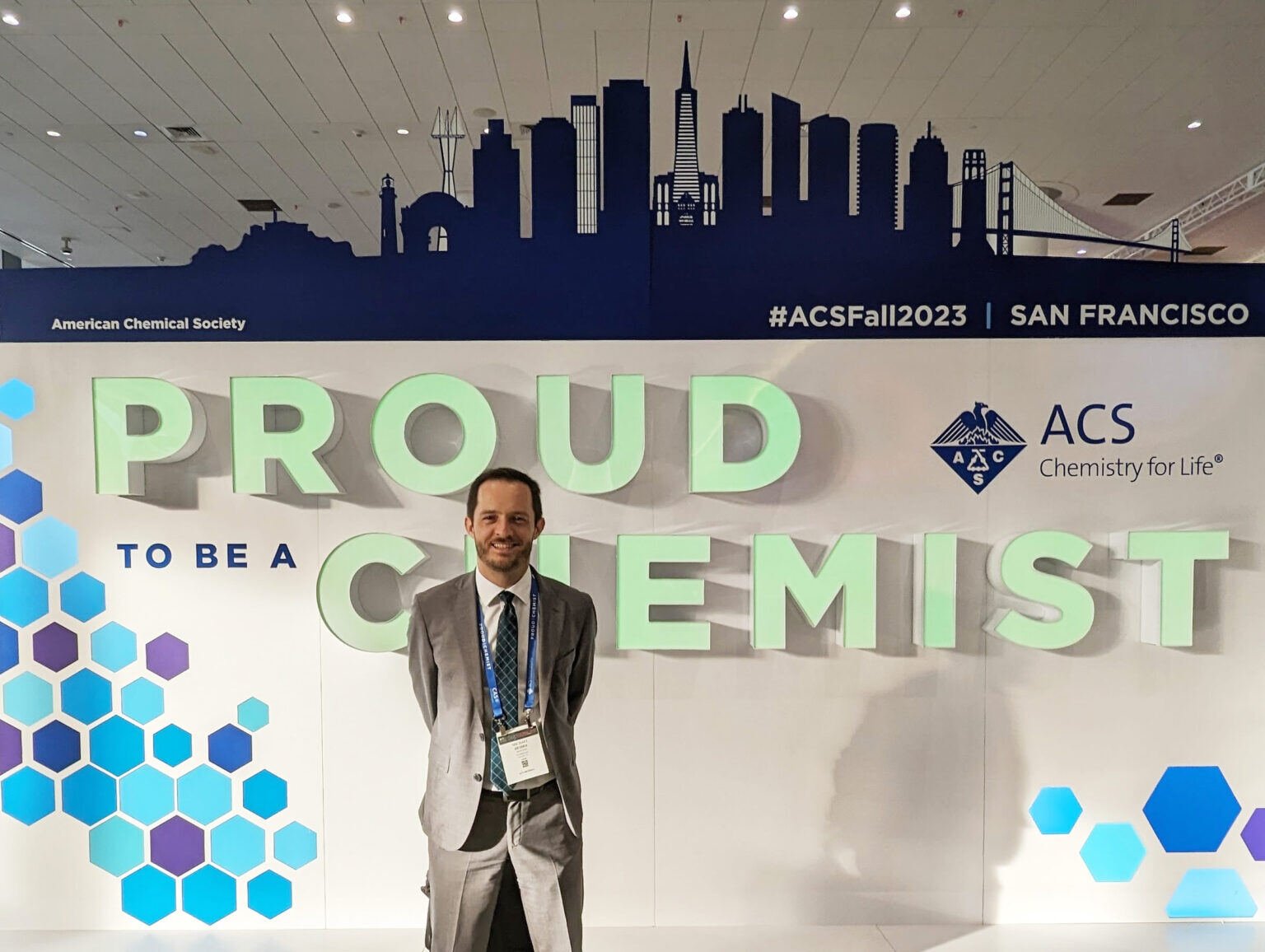
The American Chemical Society (ACS) is a premier scientific organization with members all over the world from both academia and industry. Some of my team and I recently returned from their primary annual convening, the ACS 2023 Fall Meeting, held in San Francisco.
I was honored to be an invited panelist for the Presidential Symposium AI on Science: Classroom to Publication to Boardroom and also gave a talk as part of the Application of Machine Learning in Polymers session entitled Making an Impact in Industrial Polymer Product Development with Materials Informatics. I spent most of my time attending numerous excellent presentations on data-driven chemical R&D in sessions organized by the PMSE and POLY divisions. Enthought also had a booth at the Expo, where we had many great conversations.
While there were too many great talks and discussions to detail, I want to share our top takeaways for a glimpse into what was top-of-mind this year:
1. Excitement for AI and Machine Learning
Our first observation from the conference is that many people are excited and curious about AI and machine learning (ML). There were many academics and companies presenting on these topics, enough for multiple parallel tracks across different chemistry subdomains. We frequently heard students, the next generation of scientists, say that they were eager to learn how to incorporate AI and ML into their research.
We saw similar excitement and curiosity amongst both early career and seasoned researchers in industry as well. As mentioned, one of the Presidential Symposiums was dedicated to AI, which is significant in itself, where I had a stimulating discussion with other panelists about the challenges of industry adoption. It was clear throughout the conference that industry attended the ACS conference looking to inform their R&D strategy with AI-driven solutions to accelerate scientific research.
The excitement for AI and ML was fitting and expected given that the theme of the conference was “Harnessing the Power of Data”. “Harnessing” is an action word, and the action was evident. Enthought has been developing AI and ML-driven solutions for R&D for many years, and even we saw a palpable shift in the field to actively adopt these technologies as part of the modern way to conduct research and develop new chemical products.
2. ChatGPT and Generative AI in Science
ChatGPT and large language models (LLMs) have been all the rage for nearly a year now and are still producing exciting surprises. Enthought has been active in the discussion with the broader scientific community, where we have looked at this with a scientific and practical lens (see webinar What Every R&D Leader Needs to Know About ChatGPT and LLMs). That same tempered and practical view was echoed at the conference.
As we discussed ChatGPT with other scientists, it was generally acknowledged that the use cases for ChatGPT in science are still very niche but also quite powerful. For example, as we’ve seen in our own work, text summarization does help accelerate preliminary research but is not a game changer on its own. It’s going to take a while to explore all the scientific use cases for ChatGPT.
While ChatGPT did not appear in many talks I attended, as both academia and industry are still figuring out its true potential, Generative AI certainly did. We recently wrote about this in our newsletter. There were several talks showcasing how Generative AI can be used for molecular design, from polymers to pharmaceuticals. I expect this number to grow next year as the research community explores more use cases and defines best practices for them. As we tell our clients, it’s just a matter of time before Generative AI becomes a standard tool in the molecular design toolkit.

3. Digital Skills for Scientists and Managers
The number of scientists graduating with digital skills is increasing. This is not unexpected, and there is great demand for this talent. It will however take a while before the supply of talent meets the demand, but there are ways to mitigate that (like internal training). The bigger issue we see is that most organizations are not ready to effectively leverage that talent.
Based on our conversations at the conference, and through our consulting business in general, this lack of readiness is largely an organizational and strategic issue. It takes not only the right skills to leverage AI and ML for science, but strategies for picking the right projects to work on; collaborative models that incorporate business, IT, science, and analytical stakeholders; policies to incentivize participation in digital initiatives; and critically, a desire to go beyond one-size-fits-all solutions to more varied and complex challenges. There is a big difference between ‘doing digital’ and ‘being digital.’
Some of the work presented at the conference this year will prove to be transformative, but few organizations are properly equipped to identify and quickly incorporate these innovative methods into their product development process. As the prevalence of digital and industry-specific topics grows at the conference, the ways in which industry can effectively leverage digital tools will become more evident and eventually seen as imperative as part of a continuous improvement approach. Until then, we’re here to help!
4. Open-Source for Scientific Innovation
When you see all of the work presented at the conference, it becomes clear that there is so much more room to innovate in this space. Similar technical topics appeared in multiple sub-industry tracks, but that’s how you can tell that a technology is making an impact. That is typically facilitated by the availability of open-source software (OSS) or leads to its creation. Many of us at Enthought cut our teeth in graduate school by creating and sharing open-source software that supported our scientific research.
The same thing is happening at the ACS Fall Meeting. There was an entire track dedicated to OSS this year, and so much evidence in other tracks and poster sessions for the value it brings to the community. I recommend browsing titles and looking for software that is relevant to your work. There’s a good chance someone else has at least started on a software tool to help with your current R&D challenge.
5. R&D Data Management Platforms
Data management is a big topic, so I attended the Big Data in Chemistry symposium to learn about the emerging use cases presented there. One of the industrial speakers in that track said something to the effect of, “We’re doing science and engineering. We don’t have big data. We have small data.” I found this timely, as I recently presented a webinar with C&EN on the subject.
There are as many data challenges as there are solutions. It goes to show how tricky “data management” is in materials science and chemistry specifically. We had many conversations about data-driven solutions while at the conference, and found that there is a growing acknowledgement that a focus on data management alone will not lead to accelerated innovation and better problem solving. Data management is necessary, but not sufficient, for R&D digital transformation to make a real impact. Many are disenchanted towards AI, machine learning, and digitalization when they figure this out after having invested heavily in technology that did not (and could not) meet their expectations.
We said to them what we say to our clients-innovation does not come in a box. To unlock the full potential of your scientific data and your experts, it’s imperative to take a holistic approach and look end-to-end: the full product development workflow, the right-fit technologies, and the people using the technology. You don’t have to transform the entire workflow at once, but you should start the journey with a vision of where you want to end up. From there you can be very practical about how you want to proceed given realistic budget restrictions, time constraints, and risk aversion. Without this, you will likely end up with an incomplete and disappointing solution that doesn’t actually bring real value to your organization.


The team left the ACS Fall Meeting energized about the direction of the field and excited about the focus on harnessing scientific data for discovery and product development.
Did you go? Would love to hear your thoughts – connect with me on LinkedIn.
More > Materials Science & Chemistry Resources
Click here to subscribe for news, resources and events