As a company that delivers Digital Transformation for Science, part of our job at Enthought is to understand the trends that will affect how our clients do their science. Below are three trends that caught our attention in 2022 that we predict will take center stage in 2023.
ChatGPT
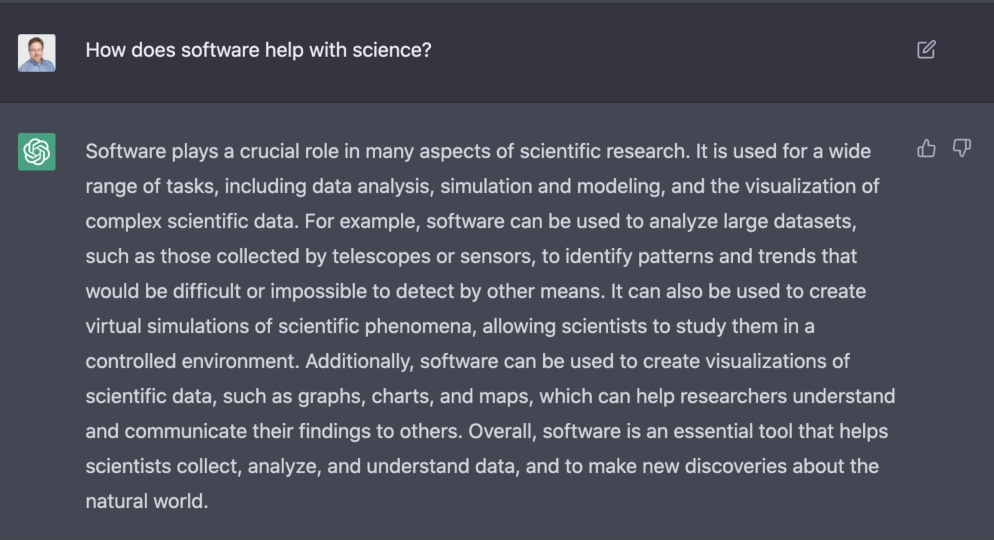
This one just showed up on the radar. ChatGPT1 is a conversational and very informative chatbot from OpenAI2. It can tell you a story, find errors in code, and sustain a conversation. There are many other blog posts about what it can do and how it works.
We’ve long believed that the role of technology in science should be to empower scientists and accelerate their work. A chatbot like ChatGPT that understands free-form or structured input and returns well-informed, improbably detailed information is an awesome example of this. This is the sort of tool that can help free highly skilled scientists from low-value work, such as information search and retrieval. We’ve seen the power of this firsthand by helping our clients make better use of their institutional knowledge and searching patents during product development. We think it won’t be long before tools like this are ubiquitous in highly specialized areas.
Data-Centric Deep Learning
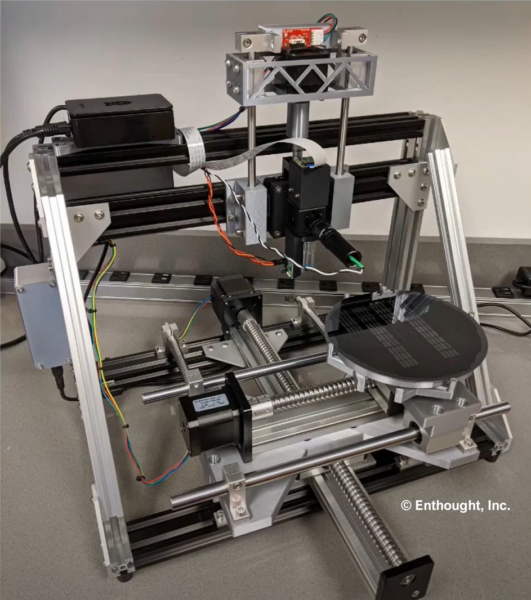
The dominant paradigm for utilizing AI is model-centric-you fix the data you’re working with and you tweak your model to get a good fit. There has been a recent shift towards data-centric AI-focus on data quality once you have a reasonable model. We recently applied this approach for an AI-driven microscope we’re developing, and improved model accuracy and eliminated a lot of model code. That was very satisfying!
The data-centric approach aligns very well with how we approach scientific data in general. Scientists use instrumentation, measurement, and analysis to understand how materials properties affect performance-those properties are features. When your measurements and analysis are inconsistent, your features aren’t going to be that useful for machine learning or anything else. (We built the microscope to address this problem, which sped up data collection and reduced human error.) Whether it’s AI or laboratory transformation, you should ask yourself, “What is the quality of my data and how do I go about improving it?”

Sustainability and Decarbonization
These are not new topics, but they really came to life in 2022. We are seeing large sustainability and decarbonization investments being made at multiple levels across the materials, semiconductor, and energy industries. Materials and Energy companies are elevating the performance targets of their energy materials and technologies, and developing new products like catalysts for carbon utilization. Development of battery materials is particularly intense. We understand why; Bloomberg says to expect 15x market growth by 20303. At SEMI SMC this year we learned about multiple climate and sustainability pledges being made by industry leaders (Intel, Micron, others). Related, SEMI recently announced the Semiconductor Climate Consortium4. (We’re happy to see multiple Enthought clients among the founding members!) In Japan, home to many of our clients, METI has established the GX League5 and is calling on all companies to consider how to spur economic growth through green transformation.
Traditional, slower discovery methods won’t be adequate to solve these big challenges as fast as we need. Digital transformation is going to be an enabler, if not a necessity, of innovation in this space. As a team of data-centric scientists and engineers, we find this all very motivating. Many people who go into science do so because we want to make a lasting impact on the world. At Enthought we harness that drive in order to help our industrial clients transform how they do science. When that local impact aligns with a trend towards the greater good, it reminds us of why we love what we do!

Contributors:
- Chris Farrow, Ph.D., Vice President, Materials Science Solutions | Chris currently leads Enthought’s Materials Science Solutions Group, where he oversees Digital Transformation solutions for Specialty Chemicals and Semiconductor industries. He holds a Ph.D. in physics from Michigan State University and degrees in physics and mathematics from the University of Nebraska.
- Tim Diller, Ph.D., Director, Digital Transformation Services | Tim loves working at the intersection of technology, commerce, and human organization. He holds three degrees in mechanical engineering, including a Ph.D. and B.S. from The University of Texas at Austin and an M.S. from M.I.T.
- Behzad Eftekhari, Ph.D., Consulting Manager | Behzad has a passion for applied, physics-based solutions. He holds a Ph.D. in petroleum engineering from the University of Texas at Austin, and a BSc in mechanical engineering from the Sharif University of Technology in Iran.
References
- ChatGPT: Optimizing Language Models for Dialogue
- OpenAI
- Global Energy Storage Market to Grow 15-Fold by 2030, Bloomberg, 10/22/22
- Semiconductor Climate Consortium
- GX League