Let’s put on our physicist lab coats for a moment and look at how heat or cold gets inside your house. Heat always moves toward cold. Therefore, if it’s hot outside, the heat is constantly trying to get into your house, and if it’s cold outside, the heat is trying to escape from your house. The most efficient way for the heat to move is through your windows.
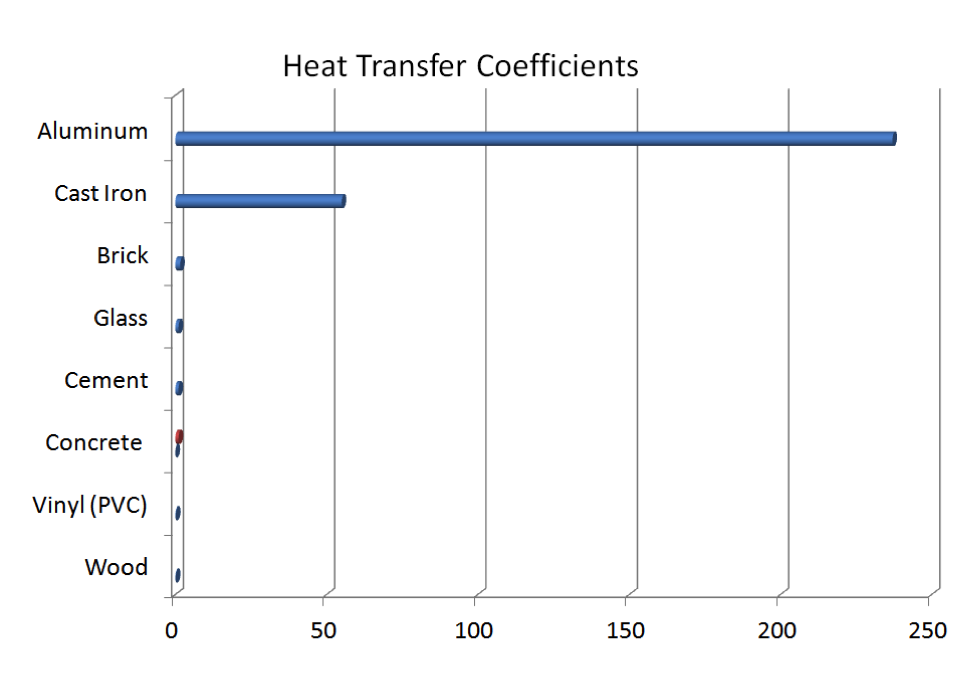
Windows are made up of several components that work together, mainly a frame and glass. Heat can pass through these different materials at different rates. If it has a high heat transfer coefficient, scientists call the material “conductive,” meaning the heat passes through quickly. The chart below shows different materials that might make up your home (except for cast iron, which is thrown in as a familiar cookware material) and the rates at which heat is transferred through them. The chart shows the materials with the lowest heat transfer coefficients (thermal insulators) at the bottom, and the highest (thermal conductors) at the top.
The numbers in the above chart are found at http://www.roymech.co.uk/Related/Thermos/Thermos_HeatTransfer.html.
You can see that in the grand scheme of heat transfer, many materials are not very good conductors. In other words, heat doesn’t blast through wood, vinyl, or even glass very easily. However, if you look at aluminum, a common window frame material, you can see that heat will either be lost or gained at a very rapid rate.
For more information on what all this means for aluminum windows, see our article entitled Should I Replace My Aluminum Windows? or feel free to contact us directly.